The $500 billion Stargate project: The U.S.-China race for AI supremacyFebruary 22, 2025
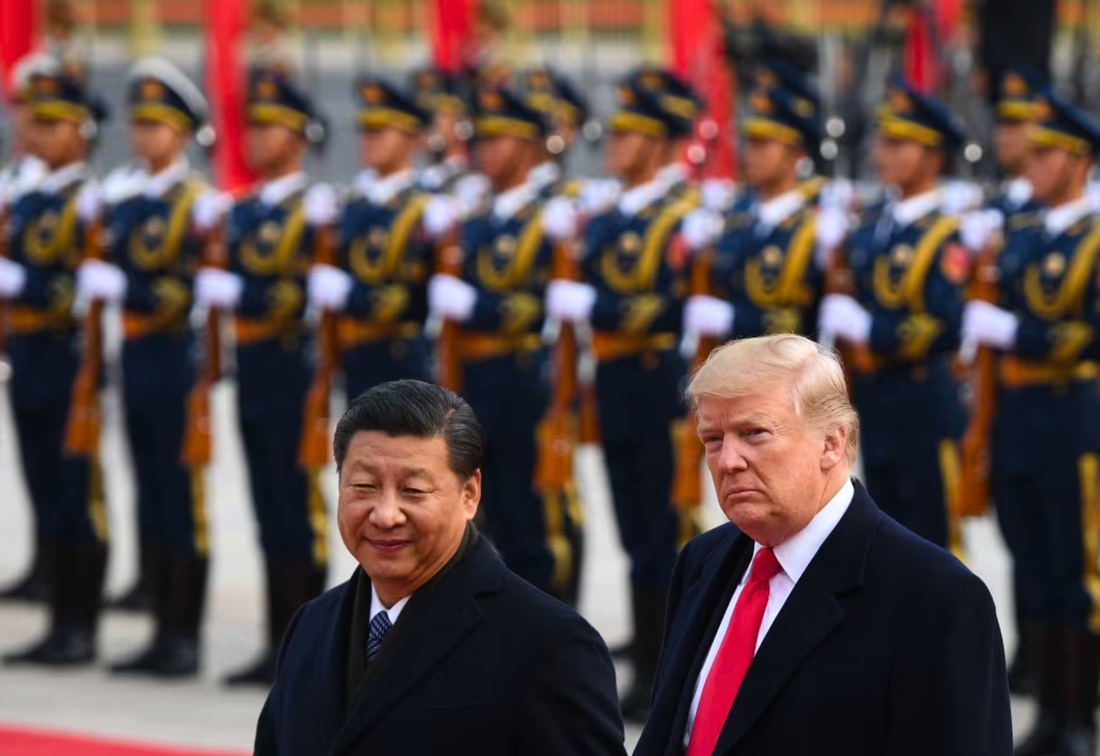
China's President Xi Jinping and President Donald Trump are set to negotiate AI policy in the upcoming years.
One of the most ambitious and high-profile projects to have emerged recently is the Stargate—a United States-based AI initiative that has reportedly attracted over $500 billion in investment over four years. The initial equity funders of Stargate include SoftBank, OpenAI, Oracle, and MGX. SoftBank and OpenAI are the lead partners for Stargate, with SoftBank holding financial responsibility and OpenAI managing operational responsibilities. Arm, Microsoft, NVIDIA, Oracle, and OpenAI are the key initial technology partners.
The $500 billion Stargate project The Stargate project has become a symbol of the United States' desire to solidify its leadership in the emerging field of artificial intelligence. While details about the project are still largely shrouded in secrecy, public reports suggest that the Stargate project aims to integrate cutting-edge technologies to develop the infrastructure needed to train and operate artificial intelligence in the United States, including 20 data centers and the electrical power to run them. The massive investment is believed to be distributed across multiple research hubs and development programs, all focused on creating autonomous systems capable of achieving tasks far beyond current capabilities. Despite its classified nature, the Stargate project’s massive scale and bold ambitions highlight the United States intention to assert dominance in the AI race. However, it hasn't been without competition, especially from China. China’s response: The Deepseek R-1 initiative In response to the Stargate project and other AI initiatives by Western powers, China launched the Deepseek initiative. This sudden entry into the large language model arena has provided China with a powerful tool to accelerate artificial intelligence adoption domestically and stimulate economic growth. Deepseek showcases China's position at the forefront of AI development, enhancing the prestige of its economy and tech ecosystem, making them more appealing to global investors. The introduction of a more affordable and efficient AI model has come at a crucial time, offering a confidence boost as Chinese leadership grapples with prolonged economic challenges, partly due to a downturn in the property market, while the threat of a fierce trade war with the United States looms. Deepseek’s R-1 reasoning model has been praised for its ability to match or even surpass leading global AI offerings, despite claims of operating on cheaper and less advanced chips. Additionally, the open-source model allows developers outside the company to repurpose it, significantly enhancing efficiency at lower operating costs. Kimi AI: The rise of a new player A newer development in the global AI race is the emergence of Kimi k1. 5, Kimi AI's latest version, an advanced artificial intelligence model developed by Beijing-based startup Moonshot AI. Kimi k1. 5 has demonstrated exceptional performance in mathematics, coding, and multimodal capabilities. Key features at a glance:
Practical applications across industries Kimi AI offers a diverse range of applications across various industries. Here are some key examples: Content creation and digital marketing: Creative professionals can harness Kimi AI to generate captivating content, brainstorm innovative ideas, and produce complementary visuals. Its multimodal capabilities enable seamless integration of text and images, making it an invaluable resource for digital marketers and content creators. Academic research: Researchers can take advantage of Kimi AI’s long-context processing and real-time search functionalities. By inputting extensive text and data, academic professionals can receive detailed analyses and summaries that enhance their research efforts. Business and financial analysis: Kimi AI excels in analyzing multiple files and retrieving real-time data, making it ideal for business documentation, financial reports, and market trend analysis. This versatility positions it as a vital tool for finance and consulting professionals. Legal document review: Law firms and legal experts can utilize Kimi AI to navigate through large volumes of case files, contracts, and legal documents. Its advanced reasoning capabilities assist in identifying key clauses and pertinent information, streamlining the document review process. Programming and technical support: Developers can depend on Kimi AI for code analysis, debugging support, and documentation generation. Its impressive performance on coding benchmarks—ranking in the 94th percentile on Codeforces—demonstrates its effectiveness in technical fields. Impact on Malaysia While the Stargate, Deepseek, and Kimi AI are based in the United States and China, their global impact is undeniable. Malaysia stands to benefit in several ways as these nations race to advance their AI capabilities. 1. Economic growth and technological development As the AI landscape continues to evolve, Malaysia can harness these global developments to fuel its own technological sector. With growing investments in AI, Malaysia’s technology industry can accelerate innovation, allowing local businesses to compete on the global stage. The introduction of AI-driven automation and analytics could drastically enhance productivity in key sectors like manufacturing, agriculture, and logistics. 2. Enhanced healthcare systems The advancements in AI-driven healthcare systems, which both the U.S. and China are focusing on, could lead to better healthcare outcomes in Malaysia. AI applications, such as predictive diagnostics and personalized treatment plans, could help Malaysia improve its healthcare services. 3. Education and skill development AI advancements could revolutionize education in Malaysia, offering personalized learning experiences through intelligent tutoring systems and adaptive learning platforms. To ensure that Malaysia’s workforce can take full advantage of these AI-driven transformations, there will be a growing need for skills development in AI, machine learning, and data science. 4. Smart infrastructure and sustainability Malaysia’s cities could benefit from smart infrastructure powered by AI, improving traffic management, waste management, and energy efficiency. Projects in AI-powered urban development could contribute to more sustainable cities, reducing costs and enhancing the quality of life for Malaysian citizens. 5. Strategic partnerships and global positioning As Malaysia continues to strengthen its relations with global powers like the U.S. and China, the country could position itself as a key player in the global AI ecosystem. By attracting investment and collaborating on AI research, Malaysia can build a technological infrastructure that will allow it to thrive in the rapidly changing world of AI. The race between the United States and China to dominate AI technology is reshaping global industries, and Malaysia must be prepared to capitalize on these advancements. The $500 billion Stargate Project, China’s Deepseek initiative, and rising artificial intelligence model Kimi AI are all leading the charge in AI development. |
EXPLORE FURTHER

|
Malaysia poised for digital healthcare revolution, says former Health director generalTan Sri Dr Noor Hisham Abdullah urges sector to adapt or risk obsolescence
|

|
Building sustainable healthcare infrastructure: Challenges and opportunitiesPotential pathways for progress
|

|
Revolutionizing healthcare: Inside Hospital Pakar Kanak-Kanak (HPKK), a smart medical facilityWhere technology and compassion converge
|

|
Machine learning and AI: A path to revolutionizing the medical landscapeNavigating the complexities of modern healthcare
|

|
Malaysia as a medical device hub: An overview of regulatory framework and industry growthPotential for robotic surgical systems investment
|

|
Emerging technologies in diagnostic accuracy to revolutionize healthcare imagingGroundbreaking advancements for patient care
|

|
Revolutionizing healthcare: Integrating IoMT for enhanced patient careEmbracing ethical principles, tackling integration challenges, and empowering medical professionals
|

|
Transforming healthcare: The integration of AI and robotics in life-or-death decisionsPrecision, efficiency, and patient-centricity in the technological revolution
|

|
Shaping the future of Asian healthcare: Insights from Malaysian health policiesPolicies across diverse industries
|

|
Artificial intelligence in IoMT: Potential for early disease detection, classification, and predictionEthical considerations for inclusivity and transparency
|