Could your ‘allergies’ actually be something else entirely?July 7, 2026

Allergic rhinitis commonly causes sneezing, nasal itching, congestion, watery eyes, postnasal drip and cough, affecting everyday comfort and wellbeing.
Rhinitis refers to inflammation of the nasal cavity. It often co-exists with sinusitis because the nasal cavity and sinuses are closely connected, with a continuous mucosal lining.
Although allergic and non-allergic rhinitis share many similar symptoms, their underlying causes differ. Consequently, much of the treatment is similar. Definition Allergic rhinitis is an Immunoglobulin E (IgE)-mediated inflammatory disease of the nasal mucosa triggered by exposure to allergens. International recommendations are based on the Allergic Rhinitis and its Impact on Asthma (ARIA) 2016 Guidelines. The prevalence of confirmed allergic rhinitis among adults in Europe ranges from 17% to 28.5%. Asthma is also commonly associated with allergic rhinitis, occurring in 15% to 38% of affected patients. "Classical symptoms of allergic rhinitis include nasal itching, rhinorrhoea, sneezing and nasal congestion. Ocular symptoms are also common. Allergic rhinoconjunctivitis is associated with itchy, red, watery eyes. Other symptoms include itching of the palate, postnasal drip and cough," explains Dr Wong Hui Tong (pictured below), Consultant Ear, Nose & Throat, Head & Neck Surgeon, during the 'Modern Diagnostics and Advanced Therapeutics in ENT Care' symposium organized by Sunway Medical Centre, Sunway City. 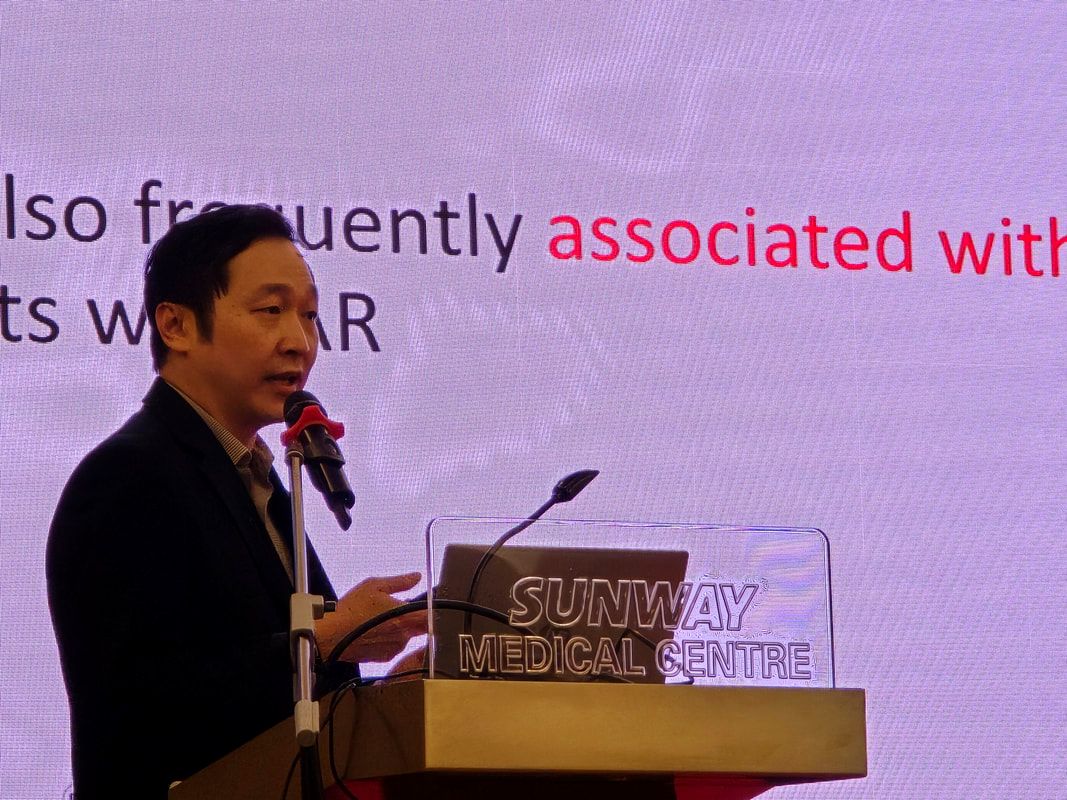
Severity of allergic rhinitis
The severity of allergic rhinitis is classified as either mild or moderate to severe. Mild allergic rhinitis does not significantly affect a person's quality of life. Moderate to severe allergic rhinitis is diagnosed when one or more of the following are present:
Symptoms are also classified according to their frequency. Intermittent symptoms occur less than four days per week or for less than four consecutive weeks, whereas persistent symptoms occur more than four days per week and for more than four consecutive weeks. Allergens Outdoor allergens include pollens and moulds. In Malaysia, pollen allergy is relatively less common due to the country's tropical climate. Indoor allergens are more frequently encountered and include:
Diagnosis of allergic rhinitis Diagnosis begins with a patient's symptoms, including:
A nasal examination is then performed. For allergic rhinitis, an allergic trigger should be identified. Allergy testing is commonly performed using an allergen-specific IgE blood test. Nasal endoscopy Nasal endoscopy is a simple procedure that does not require fasting. Patients can eat and drink normally beforehand. During the examination, patients may be asked to briefly hold their breath for several seconds while the doctor examines the nasal passages. For anxious patients, a topical anesthetic spray may be applied to improve comfort during the procedure. Nasal endoscopy can also be safely performed in children aged approximately eight to nine years. According to Dr Wong, patients who suddenly develop one-sided nasal symptoms require careful assessment. Both allergic and non-allergic rhinitis typically affect both sides of the nose, although symptoms may alternate between the left and right nostrils due to the normal nasal cycle. For example, symptoms may predominantly affect the right nostril one day and the left the following day. Allergic shiners Dark, discolored circles beneath the eyes, known as allergic shiners, are caused by nasal and sinus congestion that restricts normal blood flow from the face. The pooled blood within the small veins beneath the eyes creates the characteristic dark appearance. According to Dr Wong, allergic shiners may improve once the underlying rhinitis is adequately treated. Persistent dark circles, however, may also be influenced by factors such as sleep deprivation and inadequate rest. Adenoid facies Allergic rhinitis may cause adenoid hypertrophy because the adenoids are part of the body's immune (lymphoid) tissue. Persistent enlargement of the adenoids can obstruct the nasal airway, leading to chronic mouth breathing and, over time, the development of adenoid facies. "When you have allergic rhinitis, your adenoids become swollen because the adenoids and tonsils are immune tissues. Exposure to allergens causes these tissues to enlarge. As the adenoids become hypertrophied, the nose becomes blocked, forcing patients to breathe through their mouth, especially during sleep. Over a prolonged period, this may result in adenoid facies, characterized by an elongated face, chronic mouth opening, poor posture, a receding chin, protruding upper teeth, a high-arched palate, a narrow nose and changes to the nasal bridge." Allergy testing Sometimes, allergy testing may show a positive result even though patients report no obvious symptoms after exposure to that allergen. According to Dr Wong, this is known as sensitization. Sensitization means the immune system recognizes an allergen, but it does not necessarily result in clinical symptoms. Most allergy panels test for 30 to 80 allergens, depending on the laboratory. These commonly include:
House dust mites remain one of the most frequently identified allergens. Treatment Treatment of allergic rhinitis generally includes:
Surgery Surgery may be recommended to:
These procedures are performed under general anesthesia, followed by approximately two weeks of postoperative recovery and routine follow-up. Pharmacotherapy For patients with mild or intermittent symptoms, oral antihistamines are often sufficient. Other treatment options include:
Montelukast Montelukast is prescribed as:
However, montelukast should not be used as first-line therapy for allergic rhinitis. Although it is used in the management of both asthma and allergic rhinitis, clinicians should be aware of its potential neuropsychiatric adverse effects. Possible side effects include:
These adverse effects have been reported in patients of all ages, both with and without pre-existing psychiatric illness, during treatment or, more rarely, after discontinuation. Non-allergic rhinitis Non-allergic rhinitis occurs when patients experience rhinitis symptoms without an identifiable allergen. Typical symptoms include:
Unlike allergic rhinitis, non-allergic rhinitis is thought to result primarily from an overactive nervous system, making the nasal passages overly sensitive to environmental triggers. Common triggers include:
"Symptoms often change with temperature. Patients may develop symptoms when moving from a hot environment to a cold one, or vice versa. Viral infections, medications, hot or spicy foods and alcohol may also trigger non-allergic rhinitis." The most common cause is viral infection, which usually resolves within three to five days. However, environmental irritants and sudden weather changes are often responsible for persistent symptoms. Dust, cigarette smoke, perfumes and chemical fumes may irritate the nasal lining and trigger symptoms. Hormonal changes Hormonal changes are another recognized cause of non-allergic rhinitis. Some women develop rhinitis for the first time during pregnancy, while others notice that pre-existing symptoms become significantly worse. Hypothyroidism has also been associated with non-allergic rhinitis. Vasomotor rhinitis Vasomotor rhinitis is a common form of non-allergic rhinitis that causes:
It occurs when the blood vessels within the nose become excessively reactive. Common triggers include:
"Cold and dry air, cigarette smoke, sudden drops in temperature, air conditioning, factory pollution, vehicle emissions and certain foods can all trigger symptoms." Non-allergic rhinitis with eosinophilia syndrome (NARES) Non-allergic rhinitis with eosinophilia syndrome (NARES) is considered clinically important because it is a chronic, self-perpetuating inflammatory condition. Its significance lies in its association with several other diseases, including:
NARES may also precede the development of aspirin-exacerbated respiratory disease (AERD), a condition characterized by the combination of:
|
EXPLORE FURTHER

|
Could your child be missing sounds?Recognizing hearing loss early can prevent lifelong speech and developmental challenges
|

|
When the world starts spinning: Understanding vertigo and tinnitusCan dizziness and ringing ears be treated before they become serious?
|

|
Is my child's snoring normal, or could it signal something more serious?Understanding sleep-disordered breathing, warning signs, diagnosis and treatment options
|

|
When should I worry about voice changes?Persistent hoarseness may be more than temporary strain or a lingering cold
|